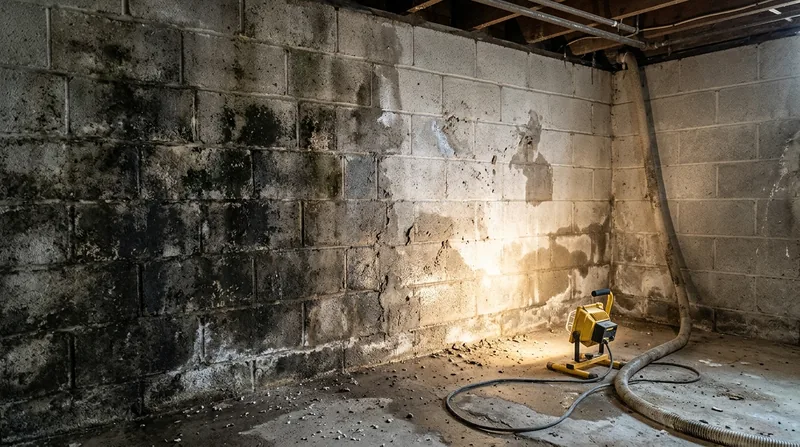




When a Middletown basement starts to smell like a wet basement, the problem is rarely just the mold you see. It is moisture, and in this township that moisture has a fingerprint. The Bayshore lowlands near Keansburg and Union Beach sit on Coastal Plain sands with a high water table. The greensand marl clay in New Monmouth and North Middletown holds water against block walls. The Navesink Highlands push runoff downhill into foundations below. We handle Basement Mold Remediation in Middletown as a moisture problem first, because treating the growth without fixing the water source is a temporary fix at best. Middletown homes range from 1700s fieldstone colonials in Middletown Village to 1980s poured-concrete basements in Chapel Hill, and each one fails differently. If you are chasing a musty smell or visible growth after a nor'easter or a summer downpour, start with the source. Our basement waterproofing service is where most of these jobs begin.
Why Basement Mold Remediation Matters in Middletown's Older and Newer Basements
Mold needs three things: moisture, organic material, and still air. Middletown basements supply all three in different ways. In Locust and along the Navesink, old brick and fieldstone foundations wick groundwater and the mortar joints stay damp for weeks. In the post-war Capes and split-levels across Lincroft, block walls seep at the cove joint after every heavy rain. In the newer poured-concrete basements out toward Holmdel and Colts Neck, the failure is often a failed sump pump or a discharge line that dumps water right back against the wall. Add humid Monmouth County summers and closed-up basements, and the conditions are there.
- Efflorescence on block or brick walls tells you water is moving through the masonry and leaving salts behind.
- A musty basement smell that gets stronger after rain points to active seepage, not just old dampness.
- Peeling paint, soft drywall at the bottom, and dark staining on joists are signs moisture has been cycling for a while.
- Standing water or a wet ring around the floor drain usually means the sump system or drain tile has failed.
- Humid summer air condensing on cool foundation walls feeds surface growth even when no water is visibly leaking.
Find the water path first, and the remediation plan writes itself. Skip that step and the growth comes back.
Key info: A Navesink-area colonial with a fieldstone foundation and a damp, musty basement after a storm is a different job than a 1970s Lincroft split-level with block walls seeping at the cove joint. The first needs foundation drainage and wall treatment. The second usually needs an interior perimeter drain and a sealed wall. We scope each one on site.
For official guidance on moisture and mold in buildings, the EPA's mold resources are a useful reference for homeowners. Local permit questions go to the Middletown Township building department, since rules vary and must be verified.
How We Run Basement Mold Remediation in Middletown from Inspection to Clearance
We work in a fixed order, and we do not skip steps. The moisture source gets identified and corrected before any surface treatment, because remediation without a moisture fix is a callback. We set up containment so spores do not spread into the living space, remove porous materials that cannot be saved, treat what remains, and dry the space with commercial dehumidification. Then we verify with moisture readings before we call it done.
- We inspect the basement and the exterior grade, checking the water table signs, wall seepage, efflorescence, and the sump basin and discharge line.
- We identify the moisture source and tell you plainly whether simple crack sealing is enough or whether hydrostatic pressure calls for an interior drain tile system.
- We set containment and negative air where needed, then remove affected drywall, insulation, and other porous materials.
- We clean and treat the remaining structural surfaces and run commercial dehumidification until moisture readings are back to normal.
- We correct the water path with drainage, wall sealing, or a sump upgrade, then verify the space is dry before we leave.
That last step is the one most homeowners remember, because it is the difference between a clean basement and a recurring problem.
Key info: A Chapel Hill colonial with a finished basement and a failed sump pump after Ida-style rainfall is a typical call. We pull the wet drywall, treat the framing, correct the discharge line, and add a battery backup so the next outage does not repeat the cycle. The battery backup sump pump is often the cheapest insurance against a repeat.
Remediation and Moisture-Control Approaches We Use in Middletown
Not every basement needs the same treatment. The table below shows the approaches we use and where each one fits, based on what we find in Middletown's mix of fieldstone, brick, block, and poured-concrete foundations.
| Approach | Description | Best for |
|---|---|---|
| Containment and surface treatment | Seal the work area, remove affected porous materials, clean and treat structural surfaces. | Localized growth on framing, joists, or wall surfaces with a known moisture source. |
| Interior perimeter drain and wall sealing | Interior drain tile at the footing, sump basin, and sealed walls to stop hydrostatic seepage. | Block and poured walls seeping at the cove joint, especially in Lincroft and New Monmouth. |
| Crack injection and foundation repair | Epoxy or polyurethane injection for active cracks, with structural repair where walls are bowing. | Visible foundation cracks and wall movement in older Middletown Village and Locust homes. |
| Dehumidification and ventilation | Commercial drying plus controlled humidity to stop condensation-driven growth in humid months. | Damp shore basements and finished spaces with no active leak but chronic mustiness. |
| Vapor barrier and wall sealing | Vapor barrier and dimple board to keep ground moisture out of the basement air. | High-water-table properties near the bay and creeks where dampness never fully dries. |
We choose the approach after the inspection, not before, and we tell you when the simpler option is the right one. For interior drainage detail, see our interior drain tile system page.
Basement Mold Remediation Cost in Middletown: What to Expect
Most basement mold jobs in Middletown start around $1,500, and that figure covers a defined scope: containment, removal of affected materials, surface treatment, and drying. From there, cost moves with the size of the affected area, whether the basement is finished, how many rooms are involved, and most of all, what the moisture fix requires. A single damp wall with surface growth is a smaller job than a finished basement that took on water and needs drainage corrected before remediation can hold.
Factors that move the number most: square footage of affected material, whether drywall and insulation must be removed and replaced, the drainage or sump work needed to stop the water, and access for equipment in tight older basements. We recommend getting two or three estimates and comparing scope line by line, not just the bottom line, because a low bid that skips the moisture fix is not a real comparison. Our full pricing overview breaks down the ranges.
Basement Mold Remediation Near Me: How to Vet a Contractor Near Middletown
Hiring for mold work is mostly about discipline. You want a contractor who treats moisture as the root cause, documents the scope, and does not sell you a drainage system you do not need. Ask direct questions and expect direct answers.
- Confirm the contractor is licensed and insured for the work, and ask for a certificate of insurance before work starts.
- Get at least two or three written estimates that list containment, removal, treatment, and drying as separate line items.
- Ask for local references from Middletown or nearby towns and call them, especially for finished basements.
- Ask who handles permits if the job touches structural foundation repair or alters drainage, since thresholds vary by jurisdiction.
- Check whether the contractor is a member of a trade association such as the Basement Health Association, which signals accountability.
A contractor who explains the moisture source in plain terms and puts the scope in writing is the one to hire. Reach us through our contact page to schedule an inspection.
Basement Mold Remediation in Middletown: Pricing Guide
| Service | Price | Details |
|---|---|---|
| Surface remediation, single area | Starting at $1,500 | Containment, removal of affected material, surface treatment, and drying for one defined area. |
| Finished basement remediation | Starting at $2,800 | Multiple rooms, drywall and insulation removal, and commercial drying before reconstruction. |
| Remediation plus drainage correction | On estimate | When hydrostatic pressure or a failed sump means the water path must be fixed first. |
| Travel | Included | in Middletown and surrounding Monmouth County towns, no separate call-out fee. |
| Estimate | Free | Response within 24h at (848) 283-6870, no obligation to book. |
Indicative pricing, the exact cost depends on square footage, finish, and site access. Free personalized estimate within 24h at (848) 283-6870.


