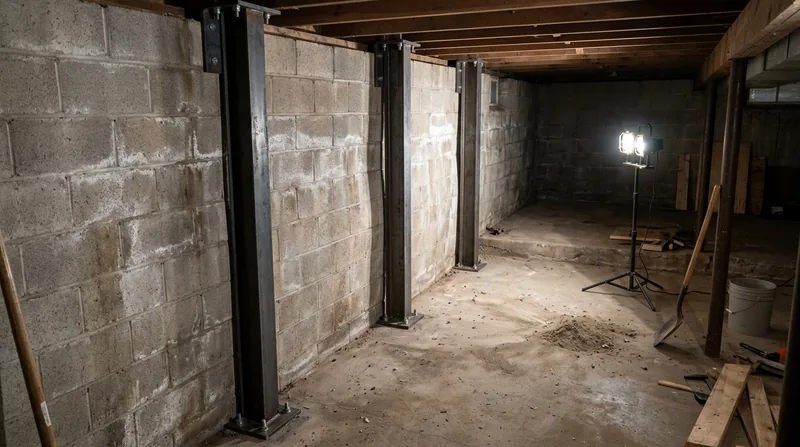




Bowing Wall Repair in Middletown: Stabilizing Foundation Walls Before They Fail
If you have noticed a basement wall leaning inward, a horizontal crack running along the block course, or a door frame that no longer sits square, you are looking at a Bowing Wall Repair in Middletown problem that will not correct itself. Middletown sits on some of the most variable ground in Monmouth County: Coastal Plain sands near the Bayshore, greensand marl clay that swells against foundation walls, and hills that push runoff downhill toward homes below. Post-war block basements in New Monmouth, Lincroft, and North Middletown take the brunt of it, because saturated marl clay and winter frost load those walls from the outside year after year. We stabilize bowing walls with carbon fiber straps, steel I-beams, or wall anchors, and we match the method to the severity of the movement and the soil behind the wall. Call (848) 283-6870 to schedule a free basement inspection, or start with our free basement inspection page to see what we check.
Why Bowing Walls Are Common in Middletown's Block and Poured-Concrete Basements
A bowing wall is almost never a sudden event. It is the end result of years of hydrostatic pressure pushing saturated soil against a foundation wall that was never designed to carry that load. In Middletown, that pressure comes from two directions: the high water table near the bay and the creeks, and the glacial clay soil that holds water against walls long after the rain stops.
- Saturated marl clay expands in winter and pushes inward on block walls in New Monmouth and Lincroft.
- Freeze-thaw cycles open horizontal cracks along mortar joints and let water into the block cores.
- Downspouts that discharge too close to the foundation concentrate runoff against the wall.
- Older fieldstone and brick foundations in Middletown Village and along the Navesink shift differently than block, and they need a different anchor layout.
- Hillside lots in the Navesink Highlands send surface water downhill toward homes below, loading walls from the uphill side.
Ignoring a bowing wall does not make it stable. Movement that measures a quarter inch this year can measure an inch two winters from now.
Key info: A homeowner in Lincroft called us after noticing a horizontal crack and a wall that had moved about 1.5 inches inward over three winters. The cause was saturated clay against a 1960s block wall with no exterior drainage. We installed carbon fiber straps and corrected the grading and downspout discharge, and the wall has held.
For the official word on structural permits and inspection requirements, check the Middletown Township building department before any structural work begins.
How We Diagnose and Repair a Bowing Wall in Middletown
We do not start with a product. We start with the wall. Before we recommend a repair method, we measure the deflection, map the crack pattern, check the soil and drainage on the outside, and look at how the floor joists and sill plate are bearing on the wall. A wall that is bowing because of hydrostatic pressure needs the water managed, not just the wall braced.
- We measure the inward deflection at multiple points and record the crack width and orientation.
- We inspect the exterior grade, downspout discharge, and any footing drain or weeping tile that may be clogged or missing.
- We check the interior for efflorescence, water staining, and evidence of ongoing seepage.
- We recommend the stabilization method: carbon fiber straps for moderate movement, steel I-beams for heavier loads, or wall anchors when the soil outside is the main driver.
- We address the water source with drainage corrections so the repair is not fighting the same pressure next season.
Every repair we do is documented with before-and-after measurements so you can see exactly what changed.
Key info: In Hazlet, a homeowner had a block wall bowing about 2 inches with visible efflorescence and a wet basement after every heavy rain. We installed steel I-beams and tied the repair into an interior drain tile system, because bracing the wall alone would have left the water problem in place. See our interior drain tile system page for how that side of the work is handled.
Bowing Wall Repair Methods We Use in Middletown
The right method depends on how far the wall has moved, what the wall is made of, and what kind of soil is pushing on it. Here is how the main approaches compare.
| Approach | Description | Best for |
|---|---|---|
| Carbon fiber straps | Straps bonded to the interior wall face resist further inward movement without excavation. | Moderate bowing (up to about 2 inches) on block walls with stable soil. |
| Steel I-beams | Vertical steel beams anchored to the floor and joists hold the wall in place under heavier load. | Walls with significant movement or high lateral soil pressure. |
| Wall anchors | Anchors driven into stable soil outside pull the wall back and hold it. | Walls where exterior soil is the primary driver and access allows excavation. |
| Drainage correction | Grading, downspout extensions, and drain tile work reduce the water loading the wall. | Any bowing wall where hydrostatic pressure is a contributing factor. |
Bowing Wall Repair Cost in Middletown: What to Expect
Bowing wall repair is not a one-price job, and any contractor who quotes a number over the phone without seeing the wall is guessing. Pricing starts from $600 for minor stabilization and drainage corrections, and climbs from there based on the method, the wall length, and how much water management is needed. Carbon fiber strap systems on a typical block wall usually land in the low thousands, while steel I-beam or wall anchor jobs on longer walls run higher.
Factors that move the price include the length of wall being stabilized, the number of straps or beams required, whether exterior excavation is needed for anchors, and whether drainage corrections are part of the scope. Getting two or three estimates is smart, and we encourage it: a good contractor will show you the measurements and explain why the method fits your wall. For a fuller breakdown of what we charge, see our pricing overview.
Bowing Wall Repair Near Me: How to Choose a Contractor Near Middletown
Hiring for structural work is different from hiring for a paint job. You want a contractor who specializes in below-grade work, carries liability and workers' compensation insurance, and can explain the repair method in plain terms. Ask for the certificate of insurance, ask for references from jobs in Middletown or nearby towns like Red Bank or Holmdel, and ask whether permits are required for your specific scope.
Permits are commonly required for structural foundation repair, and thresholds vary by jurisdiction, so confirm with the Middletown Township building department before work starts. A contractor who hesitates to pull a permit for structural work is a red flag. We are a Basement Health Association (BHA) member and we are happy to walk you through the process. Reach out through our contact page to set up a free estimate.
One more thing: ask what happens after the repair. A wall that is stabilized but still sitting in saturated clay will keep moving. The best contractors will talk about drainage and water management as part of the fix, not as an upsell.
Bowing Wall Repair in Middletown: Pricing Guide
| Service | Price | Details |
|---|---|---|
| Minor stabilization and drainage correction | Starting at $600 | Covers small-scale bracing and grading or downspout corrections; final price depends on wall length and access. |
| Carbon fiber strap system | Starting at $1,800 | Interior strap installation on a typical block wall; number of straps and wall length move the price. |
| Steel I-beam installation | Starting at $2,800 | Vertical beams anchored to floor and joists; heavier loads and longer walls increase the total. |
| Wall anchor system | On estimate | Requires exterior excavation and soil assessment, so we need an on-site look before quoting. |
| Travel | Included | in Middletown and surrounding Monmouth County towns, with no separate call-out or mileage fee. |
| Estimate | Free | Response within 24 hours at (848) 283-6870, with no obligation to book. |
Indicative pricing, the exact cost depends on square footage, finish, and site access. Free personalized estimate within 24h at (848) 283-6870.


