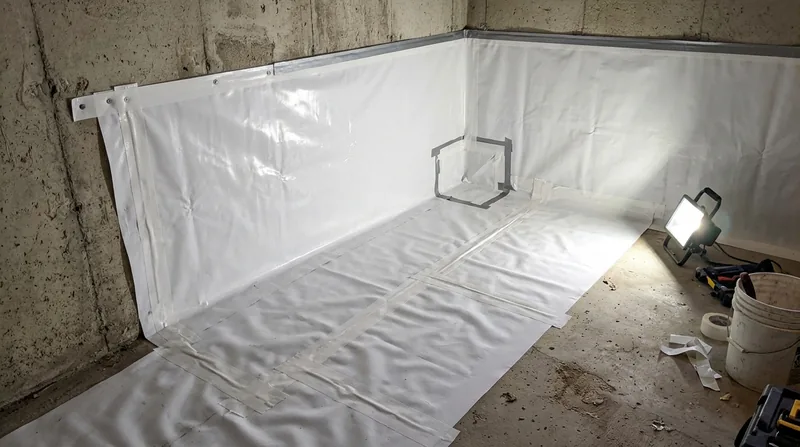




Homeowners searching for Vapor Barrier Installation in Middletown usually already know something is wrong: the basement smells musty after a wet week, the block walls sweat in July, or efflorescence keeps blooming on the lower courses. Middletown stretches from the Raritan Bayshore up into the Navesink Highlands, and that geography drives the problem. Coastal Plain sands meet a high water table near the bay and the creeks, greensand marl clay holds water tight against foundation walls, and the hills push runoff downhill toward homes sitting below. Whether you own a 1950s Cape on a block basement in New Monmouth or a 1990s Colonial with poured concrete in Chapel Hill, ground moisture vapor finds the same path in: through the concrete, the mortar joints, and the slab. A heavy-duty vapor barrier stops that vapor at the surface before it reaches your stored goods, framing, and finished space. If you have not had the basement looked at yet, start with a free basement inspection so the scope is based on what is actually happening at your walls.
Why Vapor Barrier Installation Matters in Middletown's Shoreline and Highland Basements
Middletown sits on ground that stays wet. Along the Bayshore in Keansburg, Union Beach, and Atlantic Highlands, the water table rides high and stays high after nor'easters and tropical downpours like Ida in 2021. Inland, the greensand marl clay in Lincroft and North Middletown traps water against foundation walls, and the ridges in Holmdel and Colts Neck send sheet runoff down toward homes below. That moisture does not always show up as standing water. Much of it moves as vapor through the concrete and block, which is why a basement can read dry on the floor and still rust tools, swell door frames, and grow mold on stored boxes.
- Block and poured concrete walls wick ground moisture upward and inward, and a vapor barrier gives that moisture nowhere to condense.
- Slab-on-grade floors in post-war ranches and split-levels pull vapor straight up through the concrete, especially in summer when the air above is warmer than the ground.
- Fieldstone and brick foundations in Middletown Village and along the Navesink have no modern damp-proofing, so mortar joints pass vapor freely.
- Humidity from the soil raises the dew point in the basement, which is the condition that feeds mold growth on joists, sills, and stored materials.
- Sealing the walls and slab cuts the vapor load before it reaches the space, which is far cheaper than drying out a finished lower level later.
Vapor control is the layer that works with drainage, not instead of it. If water is actually entering, the barrier is not the fix; the drain and the crack come first.
Key info: A homeowner in Locust with a 1910s Victorian on a rubble foundation called us about a musty smell that returned every June. The walls were damp to the touch but no water was pooling. A vapor barrier on the walls and slab, with sealed seams and taped terminations, dropped the basement humidity and stopped the condensation on the joists. No excavation was needed.
For the official word on how New Jersey regulates home improvement contractors, the state Division of Consumer Affairs maintains the contractor registration lookup at njconsumeraffairs.gov, and your local construction official can confirm whether a given scope needs a permit.
How We Install Vapor Barriers in Middletown Basements
We start by reading the basement, not by unrolling plastic. The first visit checks wall moisture, slab dampness, efflorescence patterns, and how the existing drainage behaves during a wet spell. If hydrostatic pressure is pushing water through the wall, we say so and steer you toward an interior drain tile system before any barrier goes up, because covering an active leak traps moisture behind the sheet. When the walls are damp but not leaking, vapor barrier installation is the right scope, and we build it in a fixed sequence.
- We inspect the walls and slab and mark any crack or joint that needs repair before covering.
- We clean and prep the surface so the adhesive and terminations bond to concrete, not to dust or efflorescence.
- We cut and fit heavy-duty barrier sheets to the wall height and slab layout, with overlaps set for the seam schedule.
- We seal every seam and tape all terminations at the top, bottom, and penetrations so vapor cannot bypass the sheet.
- We integrate the barrier with the sump basin and discharge where the floor drains, keeping the check valve and pump accessible.
- We leave the job with a walkthrough of what was covered, what was left open for inspection, and how to watch the space over the next wet season.
Every step is done so the barrier stays continuous, because a single open seam undoes the work of the whole wall.
Key info: In a 1968 split-level in New Monmouth, the slab read damp year-round and the sump pit had no sealed cover. We repaired a hairline slab crack, installed the barrier across the floor and up the block walls, and tied the sheet into the sump basin with a gasketed termination. The homeowner reported the basement stayed dry through the next spring thaw.
Vapor Barrier Approaches We Use and When Each Fits
Not every Middletown basement takes the same barrier. A poured-concrete Colonial in Holmdel and a fieldstone colonial in Middletown Village have different surfaces, different vapor profiles, and different drainage underneath. We match the material and the termination detail to the wall type and the moisture reading, and we tell you plainly when a simpler wall treatment will do the job.
| Approach | Description | Best for |
|---|---|---|
| Wall sheet barrier | Heavy-duty sheet fastened to the wall with sealed seams and taped top and bottom terminations. | Damp block or poured walls with no active seepage. |
| Slab vapor barrier | Barrier laid over the floor and lapped into the wall sheet, sealed at penetrations. | Slab-on-grade floors that sweat or stay damp in humid months. |
| Dimple board drainage mat | Drainage mat that keeps the wall surface separated and channels any residual moisture down. | Walls with minor dampness where drainage and vapor control are both wanted. |
| Sump-integrated barrier | Barrier tied into the sump basin with a sealed termination and accessible lid. | Basements with a sump pit where the floor and pit must stay connected. |
| Crack repair before barrier | Epoxy or polyurethane injection of active cracks, then barrier over a dry substrate. | Walls with a known leak point that must be closed before covering. |
The right row in that table comes from the inspection, not from a catalog, and we will tell you when your basement only needs the wall sheet and nothing more.
Vapor Barrier Installation Cost in Middletown: What to Expect
Most Middletown vapor barrier work starts around From $3/sq ft for the covered wall and floor area, and that figure is a starting point, not a flat quote. The number moves with the wall type (fieldstone and brick in Middletown Village take more prep than poured concrete in Chapel Hill), the square footage, how many penetrations and terminations need sealing, and whether a sump integration or a pre-barrier crack repair is part of the scope. Access matters too: a finished basement with paneling and dropped ceilings takes longer to work around than an open one. Get two or three written estimates on the same scope so you are comparing the same work, not the same headline rate. Our full pricing overview breaks down how the line items add up.
Choosing a Vapor Barrier Installation Contractor Near Me in Middletown
Vapor barrier work is easy to do badly: thin sheeting, unsealed seams, and terminations that peel within a season. Ask for the New Jersey contractor registration, a certificate of insurance, and references from Middletown or nearby towns where the same wall type was treated. Get more than one estimate and make sure each one states the barrier thickness, the seam and termination method, and whether any crack repair is included. Ask whether a permit applies to your scope, since work that alters drainage or the sump discharge connection can trigger one, and confirm the local construction official's requirement before work starts. If your home is in a historic district or an HOA, check those rules as well. Our contact page is the fastest way to schedule a look at your basement.
Vapor Barrier Installation Near Me: What Middletown Homeowners Should Know
When you search for vapor barrier installation near me, the honest answer is that the barrier is a moisture control measure, not a cure for an active leak. If your basement takes water after rain, the priority is drainage and crack repair first, and the barrier after. We are a Basement Health Association member and we work below grade only, so the recommendation you get is based on the foundation, not on selling a package. Call (848) 283-6870 and we will tell you which layer your basement actually needs.
Vapor Barrier Installation in Middletown: Pricing Guide
| Service | Price | Details |
|---|---|---|
| Wall vapor barrier | Starting at $3/sq ft | Heavy-duty sheet, sealed seams, taped terminations; price moves with wall type and prep. |
| Slab vapor barrier | Starting at $3/sq ft | Floor sheet lapped into wall barrier, penetrations sealed; moves with square footage and access. |
| Sump-integrated barrier | On estimate | Barrier tied into the sump basin with sealed termination; needs an on-site look first. |
| Crack repair before barrier | On estimate | Epoxy or polyurethane injection of active cracks before covering; priced per crack. |
| Travel | Included | in Middletown and surrounding areas, no separate call-out or mileage fee |
| Estimate | Free | Response within 24h at (848) 283-6870, no obligation to book |
Indicative pricing, the exact cost depends on square footage, finish, and site access. Free personalized estimate within 24h at (848) 283-6870.


